
Table of Contents
- What Capital Positioning Means for Developers
- Risk Mitigation in Property Development Starts Before the First Draw
- Public-Private Partnership Funding Models and the Capital Stack
- Navigating Municipal Development Regulations Without Stalling Your Capital
- Where Capital Positioning Strategies Matter Most: Market Cycles and Cash-Flow Resilience
- Building Investor Trust Through Transparency and Predictable Reporting
- Conclusion: Positioning Capital Before You Need It
- Frequently Asked Questions
Last Updated: September 28, 2026
What Capital Positioning Means for Developers
Capital positioning is the practice of arranging your funding sources, timing, and terms before you need the money, so each project phase draws on the right type of capital at the right moment. At RC Funding, we treat it as the difference between reacting to a lender’s terms and setting them yourself.
Most developers learn this the hard way. They secure a construction loan, start grading, and then discover the permanent financing won’t close until the building hits a stabilization threshold they never modeled. The gap between those two events is where projects die.
Capital positioning strategies matter for developers because they determine whether you control your project’s timeline or your capital stack controls it. Traditional project financing asks a single question: can you repay this loan? Capital positioning asks a harder one: which combination of debt, equity, and public money keeps this project solvent through every phase, including the ones where nothing is generating revenue yet.
U.S. Department of Housing and Urban Development guidance on community development financing
How It Differs From Traditional Project Financing
Traditional financing is transactional. You present a project, a lender prices the risk, and you close. The relationship ends at the closing table.
Capital positioning is structural. It starts with the question of what the project needs to survive, not what a single lender will approve. That means mapping every phase against its funding requirement, identifying which sources can flex when a schedule slips, and building in redundancy before a single commitment is signed.
The practical difference shows up when something goes wrong. A project financed transactionally has one path forward. A project with positioned capital has options.
Risk Mitigation in Property Development Starts Before the First Draw
Risk mitigation in property development works best when it begins during due diligence, not during construction. The risks that sink projects, environmental conditions, zoning contingencies, community opposition, and municipal approval timelines, are all visible early if you know where to look.
A common mistake is treating the environmental review as a box to check rather than a design constraint. Developers who review site conditions, prior land use, and municipal records before committing capital routinely avoid the delays that catch others off guard. The cost of that review is trivial compared to a stalled draw.
Pull the property’s full regulatory history before you make an offer. Prior uses, outstanding violations, and pending zoning changes are public records, and they tell you more about your timeline than any broker’s pro forma.
The same logic applies to community conditions. Understanding who lives near the site, what they’ve opposed before, and what the municipality has promised them gives you use in shaping a project that draws support instead of resistance.
Public-Private Partnership Funding Models and the Capital Stack
Public-private partnership funding models combine public money, tax incentives, and private capital into a single capital stack, with each layer taking a different position on risk and return. Getting the order right matters more than getting the total right.
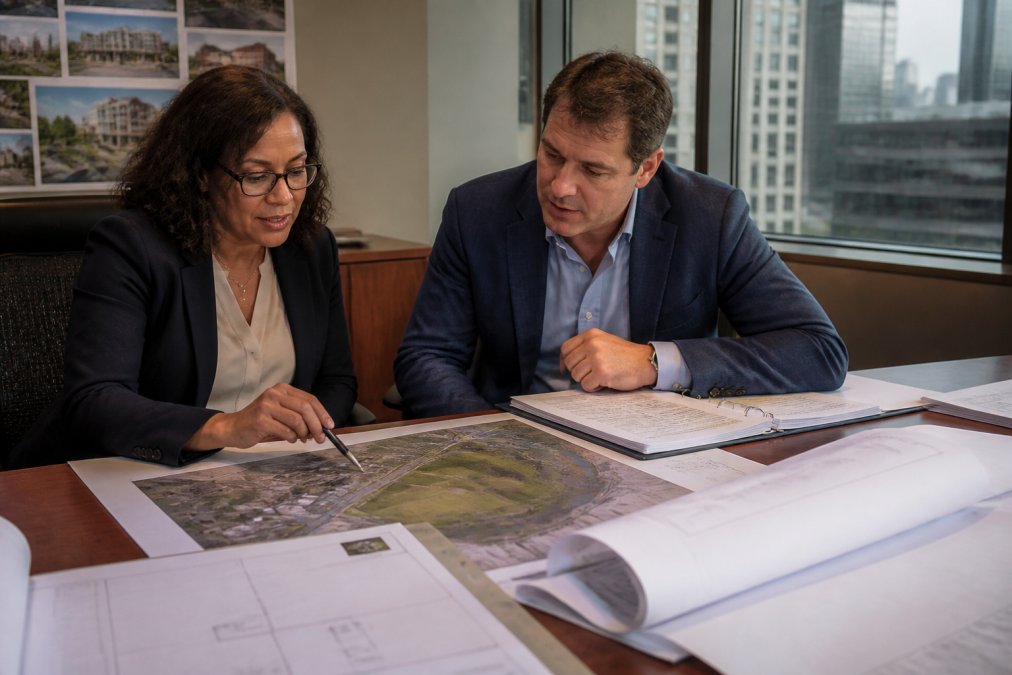
The typical stack runs from senior debt at the bottom through mezzanine financing, public subordinate funding, and equity at the top. Each layer has its own underwriting standard, its own timeline, and its own appetite for delay.
| Capital Layer | Typical Position | What It Cares About Most |
|---|---|---|
| Senior debt | First lien | Collateral value and absorption rates |
| Public subordinate funding | Below senior | Community benefit and compliance milestones |
| Mezzanine or structured debt | Between debt and equity | Debt-to-equity ratio and exit timing |
| Sponsor equity | Last in line | Long-term value and franchise value |
Tax-Efficient Capital Structuring: The Overlooked Layer
Most capital stack discussions stop at debt and equity. But for developers, the tax treatment of each layer can change the effective cost of capital by several percentage points. This is where tax-efficient capital structuring becomes a competitive advantage.
Consider how different funding sources are taxed. Municipal bonds used for public infrastructure often provide tax-exempt interest to investors, which means the developer can access lower-cost debt. Federal programs like Opportunity Zones allow developers to defer or eliminate capital gains taxes on reinvested profits, but only if the project meets specific timing and investment thresholds. Historic tax credits can offset federal tax liability dollar-for-dollar, effectively reducing the equity requirement.
The key is to sequence these benefits. A common pattern is to layer a historic tax credit with a Opportunity Zone fund, but the two have different recapture rules and compliance periods. If you exit the Opportunity Zone investment too early, you trigger the deferred gain. If you fail to maintain the historic structure, you lose the credit. Most practitioners find that the tax tail should not wag the development dog, but ignoring it entirely leaves money on the table.
Before you finalize your capital stack, run a simple tax sensitivity analysis. Ask your accountant: what is the after-tax cost of each layer? You may find that a slightly higher interest rate on a tax-exempt bond is cheaper than a lower rate on a taxable loan.
Matching Debt and Equity to Project Phases
Each phase of a development has a different risk profile, and the capital should match it. Predevelopment is the riskiest phase and the hardest to finance with debt, which is why patient capital and equity belong there. Construction carries execution risk but a clearer path to completion, so structured debt fits. Stabilization is where permanent financing takes over.
Mismatching phases and capital is the single most common cause of a capital campaign that stalls. A developer who funds predevelopment with short-term debt has created a maturity wall before the project has produced anything. The tax angle adds another layer: if you use Opportunity Zone equity for predevelopment, you need to ensure the project meets the substantial improvement requirement within 30 months, or you lose the tax benefit. That timeline often conflicts with slow entitlement processes, so you must sequence carefully.
Navigating Municipal Development Regulations Without Stalling Your Capital
Municipal approvals are where capital positioning strategies matter most, because every month of delay costs money whether or not the project is moving.
U.S. Environmental Protection Agency brownfields and land revitalization resources
Never assume a public funding award is unconditional. Most carry compliance milestones, and missing one can suspend the entire disbursement, not just that layer of the stack.
Technology has changed how this gets managed. Modern capital tracking platforms let developers map approval milestones against draw schedules in real time, so a slipping permit shows up as a funding gap weeks before it becomes a crisis. That’s a meaningful shift from the spreadsheet-and-email approach most teams still use.
Where Capital Positioning Strategies Matter Most: Market Cycles and Cash-Flow Resilience
Market cycles expose weak capital structures. In an expanding market, almost any stack works because absorption rates and rising values paper over structural problems. When the cycle turns, those problems become the whole story.
Crisis-Mode Capital Preservation: The Defensive Playbook
When a downturn hits, the first instinct is to cut costs. But the wrong cuts can kill a project faster than the downturn. Crisis-mode capital preservation is about protecting the capital you have while keeping the project alive long enough to reach the other side.
Technology-Driven Capital Tracking for Resilience
You cannot preserve what you cannot see. Most developers still manage capital with spreadsheets and email, which means they discover a funding gap weeks after it appears. Modern capital tracking platforms let you map every draw, every compliance milestone, and every covenant test in real time. That visibility is what turns a crisis into a manageable event.
The capital stack that survives a downturn isn’t the one with the lowest cost of capital. It’s the one with the fewest single points of failure and the most visibility into what is coming next.
Building Investor Trust Through Transparency and Predictable Reporting
Investor trust is built on predictability, not performance. Investors forgive a project that misses a projection. They don’t forgive one that surprises them.
U.S. Securities and Exchange Commission guidance on investor disclosures
Conclusion: Positioning Capital Before You Need It
The hardest part of capital positioning is that it demands work when nothing appears to be wrong. Building a reserve, mapping every funding source against its compliance conditions, and preparing a crisis plan all feel unnecessary during a strong market. They’re the reason some developers survive the next downturn and others don’t.
Frequently Asked Questions
What is capital positioning in real estate development?
Capital positioning is how a developer arranges funding sources, timing, and terms before committing to a project. It covers the capital stack (senior debt, mezzanine, equity), the order in which each source is drawn, and how the structure holds up under different market conditions. Unlike traditional project financing, which often starts at the loan application, capital positioning begins with the site itself: zoning exposure, community conditions, and hidden risks that affect how lenders and investors will price their participation.
How does early-stage capital strategy prevent project disruptions?
Most delays trace back to issues that were visible early but unaddressed: unclear municipal conditions, unresolved community concerns, or a funding structure that assumed a smooth approval path. When developers map risk mitigation in property development before major commitments, they can sequence due diligence, stakeholder engagement, and financing conversations in the right order. That reduces the chance of a lender pulling back or a municipality adding conditions after the capital stack is already set.
How do federal and municipal regulations impact capital deployment strategies?
Regulations shape both cost and timing. Environmental review requirements, zoning overlays, and local approval processes determine when you can draw funds and what conditions attach to them. Public-private partnership funding models often carry compliance strings, such as prevailing wage or reporting requirements, that affect project budgets. Understanding these before structuring your capital stack lets you match funding sources to the phases where regulatory risk is lowest.
What role does risk mitigation play in capital positioning for developers?
Risk mitigation is the foundation of capital positioning. Lenders and investors price risk based on what they can see and verify. If a developer can demonstrate that environmental conditions, community concerns, and regulatory pathways have been examined and addressed, the project becomes more predictable. That predictability often translates into better terms, faster closings, and stronger investor confidence across market cycles.